Customer Retention Email Strategy: Tips, Tricks, and More
A comprehensive customer retention email strategy is one of the most efficient ways to increase profitability without increasing acquisition spend.
 Ayesha Ejaz
On this page
- What is a Retention Email?
- The Essential Customer Retention Emails You Must Set Up
- Elements of a High-Converting Customer Retention Email
- Boosting Customer Retention: Advanced Tips and Strategies
- Sample Professional Customer Retention Email Template
- Measuring Success: Key KPIs for Retention Email Marketing
- Connecting Metrics to Business Impact
- Wrapping Up
Customer acquisition costs continue to rise across paid media channels, while customer attention spans shrink. For marketing managers responsible for revenue growth, this creates a structural challenge: growth cannot rely solely on new customer acquisition.
This is where a structured customer retention email strategy becomes a revenue engine rather than a support function.
Retention email marketing drives:
- Higher customer lifetime value (CLV)
- Increased repeat purchase rate
- Improved subscription renewals
- Reduced churn
- Stronger brand affinity
- More predictable revenue forecasting
In this comprehensive guide, we will break down what a customer retention email is, why it is underutilized, which retention campaigns are essential, and how leading brands execute high-performing customer retention email campaigns.
What is a Retention Email?
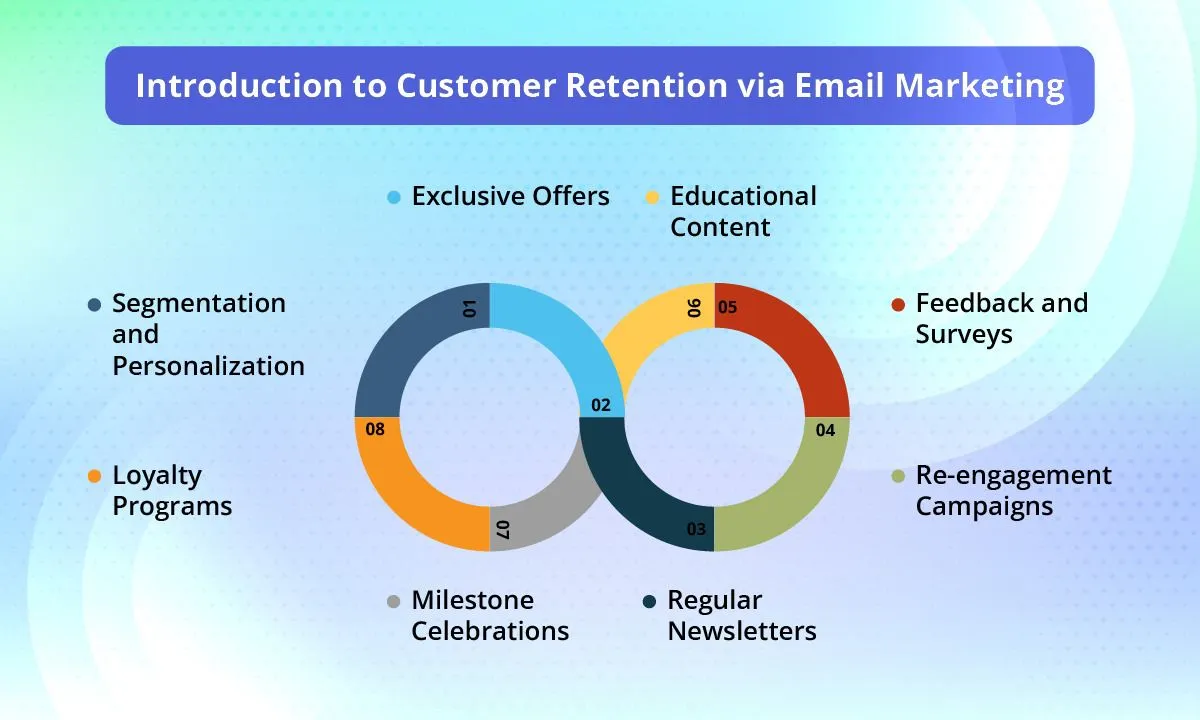
A customer retention email is a lifecycle-driven email designed to maintain, deepen, or reactivate engagement after a customer’s initial conversion.
Unlike acquisition emails, which focus on prospect conversion, retention emails aim to:
- Encourage repeat purchases
- Increase product adoption
- Reinforce value perception
- Prevent churn
- Promote loyalty and advocacy
Retention emails are typically automated, behavior-triggered, and personalized based on customer data.
In advanced retention frameworks, emails are aligned with:
- Customer lifecycle stages
- Behavioral triggers
- Predictive churn signals
- Revenue potential segments
Why Are Retention Emails Underrated?
Despite their ROI potential, retention emails are often deprioritized.
Common reasons include:
- Acquisition bias — Paid growth is easier to measure in dashboards.
- Lack of lifecycle mapping — Teams don’t have structured post-purchase flows.
- Limited segmentation — Generic campaigns reduce effectiveness.
- Underutilized automation tools — Platforms are used for broadcasts rather than behavioral triggers.
However, research consistently shows that increasing retention by even 5% can significantly improve profitability due to reduced CAC amortization and increased LTV.
For SaaS companies, retention directly influences:
- Monthly recurring revenue (MRR)
- Net revenue retention (NRR)
- Expansion revenue
- Churn rate
Retention email marketing is not a tactical add-on; it is a strategic revenue lever.
The Essential Customer Retention Emails You Must Set Up
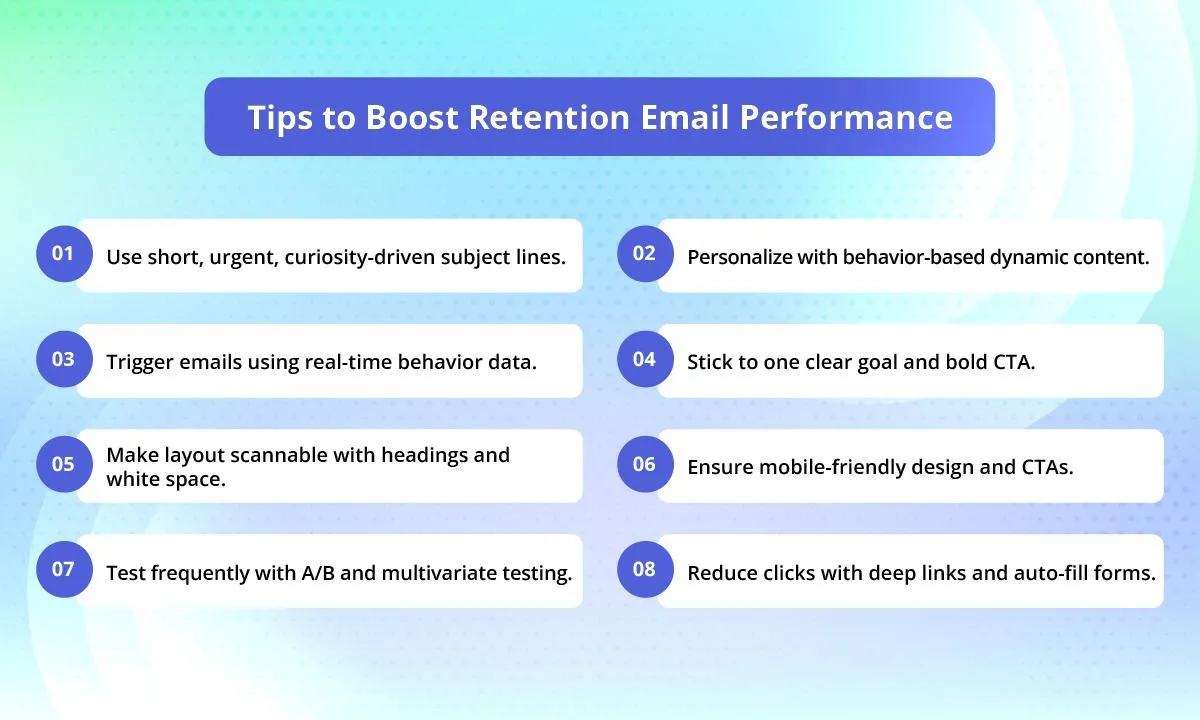
Marketing managers should implement a structured lifecycle system rather than isolated campaigns. Below are essential customer retention email campaigns across industries.
1. Welcome & Onboarding Series
Objective: Establish value quickly and reduce early churn.
This series sets expectations and guides customers toward activation milestones.
Best practices:
- Deliver within minutes of signup or purchase.
- Break onboarding into 3–5 educational steps.
- Highlight key features progressively.
- Include a clear “next step” CTA in each email.
For SaaS customer retention email campaigns, onboarding completion rates strongly correlate with long-term retention.
2. Post-Purchase Reinforcement Emails
Objective: Reduce buyer’s remorse and encourage repeat purchases.
This email typically includes:
- Order confirmation
- Usage instructions
- Product education
- Cross-sell recommendations
- Review requests
Ecommerce brands often see measurable uplift in repeat purchase rate when post-purchase emails include personalized product recommendations.
3. Educational or Value-Driven Content Emails
Objective: Reinforce product value over time.
These emails:
- Share tutorials
- Highlight advanced features
- Provide industry insights
- Showcase case studies
Value-driven retention emails reduce dependency on discount-based re-engagement.
4. Loyalty & Rewards Campaigns
Objective: Incentivize repeat behavior.
Effective loyalty emails include:
- Point balance reminders
- Tier upgrades
- Exclusive member offers
- Birthday or anniversary rewards
Psychological principle leveraged: commitment and reward reinforcement.
5. Re-Engagement Campaigns
Objective: Reactivate dormant customers.
Trigger thresholds vary by industry:
- Ecommerce: 60–90 days inactivity
- SaaS: 14–30 days login inactivity
- Subscription: Missed payment or renewal risk
Effective re-engagement emails:
- Acknowledge inactivity
- Re-emphasize value
- Offer incentive (if necessary)
- Provide a frictionless return path
These are among the most searched customer retention email examples because of their high ROI when executed properly.
6. Renewal & Subscription Reminder Emails
Objective: Reduce involuntary churn.
Best practices:
- Send 7–14 days before renewal.
- Highlight benefits and usage stats.
- Offer upgrade options.
- Provide easy payment update links.
For subscription brands, this is a critical pillar of customer retention email marketing.
7. Feedback & Churn-Prevention Emails
Objective: Understand and prevent churn.
When customers show churn signals:
- Reduced usage
- Cancellation attempt
- Downgrade request
Send:
- Feedback surveys
- Assistance offers
- Personalized outreach
Proactive intervention can significantly reduce churn rates.
Elements of a High-Converting Customer Retention Email
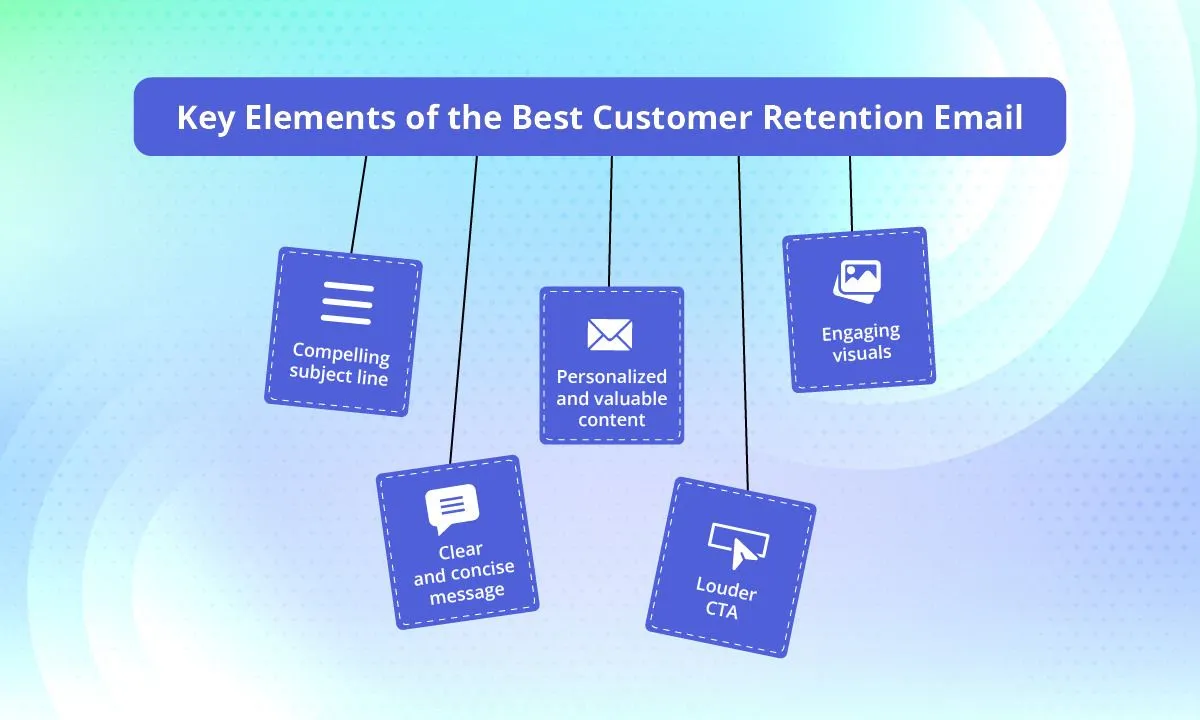
A well-designed customer retention email template should combine psychological triggers with technical optimization.
1. Subject Line Optimization
Your subject line influences open rate, which directly impacts campaign performance.
Effective subject lines:
- Use personalization tokens
- Focus on benefits
- Create mild urgency
- Avoid excessive promotional language
Examples:
- “You’re Close to Your Next Reward”
- “We Added Something New for You”
- “Before Your Subscription Renews…”
A/B testing subject lines should be continuous.
2. Clear, Singular Call to Action (CTA)
Each retention email should focus on one primary objective.
Common CTAs:
- “Resume Your Subscription”
- “Shop Your Favorites”
- “Explore New Features”
- “Complete Your Setup”
Multiple CTAs dilute conversion rates.
3. Engaging Visual Hierarchy
Retention emails should:
- Be mobile-optimized
- Use scannable layouts
- Maintain brand consistency
- Emphasize CTA visually
Design clarity reduces cognitive load.
4. Valuable, Contextual Content
Discount-heavy retention strategies train customers to wait for promotions.
Instead, prioritize:
- Education
- Social proof
- Product updates
- Personalized recommendations
Long-term loyalty comes from perceived value, not constant incentives.
5. Personalization & Segmentation
Advanced segmentation transforms generic campaigns into high-performing ones.
Segment by:
- Purchase frequency
- Product category interest
- Average order value
- Engagement recency
- Lifecycle stage
- Subscription tier
Dynamic content blocks increase relevancy inside a single campaign.
6. Social Proof & Trust Signals
Retention emails benefit from:
- Testimonials
- User milestones
- Case studies
- Community size
- Ratings and reviews
Trust reinforcement reduces churn risk.
7. Accessible Support & Contact Information
Customers should easily access:
- Help centers
- Support chat
- Account management
- FAQs
Accessibility increases perceived reliability.
Boosting Customer Retention: Advanced Tips and Strategies
Retention optimization requires continuous refinement.
Segment for Success
Segmentation is the foundation of scalable customer retention email strategies.
High-value segments may receive:
- Early product access
- Exclusive perks
- Upsell campaigns
Low-engagement segments may receive:
- Educational series
- Incentivized reactivation
Granular segmentation increases engagement metrics significantly.
Create a Positive Customer Experience Beyond Email
Email cannot compensate for poor customer experience.
Focus on:
- Fast delivery
- Transparent pricing
- Responsive support
- Seamless UX
Retention is cross-functional, not just marketing-driven.
Optimize Timing and Frequency
Over-emailing causes fatigue; under-emailing causes forgetfulness.
Best practices:
- Map email frequency to lifecycle stage.
- Suppress inactive users from excessive sends.
- Use behavioral triggers instead of fixed schedules.
Use Data to Predict Churn
Advanced retention teams:
- Monitor login frequency
- Track feature usage
- Analyze repeat purchase intervals
- Score churn probability
Predictive segmentation enhances proactive outreach.
Sample Professional Customer Retention Email Template
Subject: Let’s Pick Up Where You Left Off
Hi [First Name],
We noticed you haven’t logged in recently. Since your last visit, we’ve introduced new features designed to help you achieve [specific benefit].
Here’s what’s new:
- [Feature or update]
- [Improvement or enhancement]
- [Limited-time benefit, if applicable]
Click below to continue where you left off.
[Primary CTA Button]
If you need assistance, our support team is ready to help.
Best regards,
[Company Name]
Measuring Success: Key KPIs for Retention Email Marketing
Retention email marketing should be evaluated through a revenue lens not vanity engagement metrics alone. While opens and clicks provide directional insights, marketing managers must connect retention emails to long-term customer value and revenue stability.
Below is a detailed breakdown of the most important KPIs and how they should be interpreted.
1. Repeat Purchase Rate
Definition:
The percentage of customers who make more than one purchase within a defined time period.
Formula:
(Number of customers with 2+ purchases ÷ Total customers) × 100
Why it matters:
For ecommerce and DTC brands, repeat purchase rate is a primary indicator of retention success. A strong post-purchase and loyalty email sequence should directly increase this metric.
What to monitor:
- Change in repeat rate after implementing automation flows
- Repeat rate by segment (VIP vs. first-time buyers)
- Time between first and second purchase
If your customer retention email campaigns are effective, repeat purchase rate should trend upward over time.
2. Churn Rate
Definition:
The percentage of customers who stop purchasing, cancel subscriptions, or disengage during a specific period.
Formula (SaaS):
(Customers lost during period ÷ Customers at start of period) × 100
Why it matters:
Retention emails aim to reduce churn by reinforcing value and preventing cancellations.
For subscription businesses, even small churn reductions significantly impact revenue predictability.
What to analyze:
- Churn by acquisition channel
- Churn by customer cohort
- Churn after re-engagement campaigns
- Voluntary vs. involuntary churn
A strong customer retention email strategy should reduce churn especially in at-risk segments.
3. Net Revenue Retention (NRR)
Definition:
The percentage of recurring revenue retained from existing customers, including expansions, upgrades, and cross-sells.
Formula:
((Starting Revenue – Churned Revenue + Expansion Revenue) ÷ Starting Revenue) × 100
Why it matters:
NRR is a gold-standard SaaS metric. An NRR above 100% means expansion revenue offsets churn.
Retention emails influence NRR by:
- Promoting feature upgrades
- Encouraging plan expansions
- Preventing downgrades
For SaaS customer retention email campaigns, this KPI connects email strategy directly to board-level metrics.
4. Customer Lifetime Value (CLV)
Definition:
The total revenue expected from a customer throughout their relationship with your business.
Why it matters:
CLV reflects the cumulative effect of retention efforts.
When retention emails:
- Increase purchase frequency
- Extend subscription duration
- Encourage upsells
CLV rises.
Strategic implication:
If CLV increases, you can afford higher acquisition costs without hurting profitability.
Retention email marketing should aim to systematically increase CLV over time.
5. Open Rate
Definition:
The percentage of recipients who open your email.
Why it matters:
Open rate measures subject line effectiveness and brand familiarity.
However:
- Privacy changes have reduced open rate reliability.
- Opens do not equal revenue.
Use open rate as a directional indicator, not a success metric.
6. Click-Through Rate (CTR)
Definition:
The percentage of recipients who click on at least one link within the email.
Why it matters:
CTR indicates message relevance and CTA clarity.
Low CTR may signal:
- Weak personalization
- Unclear messaging
- Poor segmentation
High CTR suggests your customer retention email template aligns with audience intent.
7. Conversion Rate
Definition:
The percentage of recipients who complete the desired action (purchase, renewal, upgrade).
Why it matters:
This is where engagement turns into revenue.
Monitor:
- Conversion rate by lifecycle stage
- Conversion rate by segment
- Conversion rate by incentive type
Retention emails should be optimized toward conversion — not just engagement.
8. Revenue per Email (RPE)
Definition:
Total revenue generated ÷ Number of emails sent.
Why it matters:
RPE connects email campaigns directly to financial performance.
It allows marketing managers to:
- Compare flows vs. broadcasts
- Evaluate re-engagement ROI
- Justify automation investments
This is one of the most practical metrics for demonstrating the financial impact of customer retention email campaigns.
9. Reactivation Rate
Definition:
The percentage of inactive customers who re-engage after a reactivation campaign.
Why it matters:
Dormant customers represent previously acquired CAC. Reactivating them is often more cost-effective than acquiring new ones.
Monitor:
- Reactivation by inactivity duration
- Revenue from reactivated customers
- Long-term retention of reactivated segments
Effective customer retention email strategies should include structured win-back campaigns with measurable reactivation benchmarks.
Connecting Metrics to Business Impact
Retention is not measured by opens alone — revenue impact matters most.
To evaluate success properly:
- Tie engagement metrics to revenue metrics.
High CTR with low conversion signals friction post-click. - Analyze cohort performance.
Measure retention improvements across acquisition cohorts. - Measure incremental lift.
Compare customers exposed to retention campaigns vs. control groups. - Prioritize long-term value over short-term discounts.
Discount-heavy campaigns may boost short-term revenue but harm margins.
A Practical KPI Framework for Marketing Managers
For operational clarity:
Tier 1 (Executive-Level Metrics):
- Net Revenue Retention (NRR)
- Customer Lifetime Value (CLV)
- Churn Rate
- Revenue per Email
Tier 2 (Performance Metrics):
- Conversion Rate
- Reactivation Rate
- Repeat Purchase Rate
Tier 3 (Diagnostic Metrics):
- Open Rate
- Click-Through Rate
This tiered structure ensures retention email marketing is evaluated strategically rather than tactically.
Wrapping Up
A comprehensive customer retention email strategy is one of the most efficient ways to increase profitability without increasing acquisition spend.
To summarize:
- Retention drives sustainable revenue.
- Lifecycle automation ensures scalability.
- Segmentation enhances relevance.
- Personalization improves engagement.
- Value-driven content builds long-term loyalty.
For marketing managers across ecommerce, SaaS, and subscription-based businesses, retention email marketing is no longer optional it is a competitive advantage.
The companies that win are not those that acquire the most customers, but those that retain them the longest.